
Crash Test Dummies
Saudi NCAP uses a comprehensive family of crash test dummies and specialised test devices—each precisely designed to simulate human physical characteristics and measure impact forces during collisions. These Anthropomorphic Test Devices (ATDs) range from full-body dummies with hundreds of sensors to specialised impactors and moving targets that replicate real-world crash scenarios. Together, they provide the critical data needed to assess how well vehicles protect occupants and vulnerable road users.
Adult Occupant Dummies
THOR 50th Percentile Male
Represents
Average adult male
Usage
Frontal impact tests
THOR represents the pinnacle of crash test dummy technology—the world's most advanced anthropomorphic test device. First adopted by Saudi NCAP in 2020, THOR measures forces applied to the human body by vehicle restraint systems during frontal impacts with unprecedented accuracy. The dummy records detailed loading data from the head striking hard surfaces such as the steering wheel, chest loading from airbag and seatbelt forces, and leg and hip contact with the instrument panel. Its dimensions and biofidelic mechanical properties accurately replicate an average adult male.
Test Application:
Adult occupant protection: Driver position in frontal impact – Mobile Progressive Deformable Barrier test
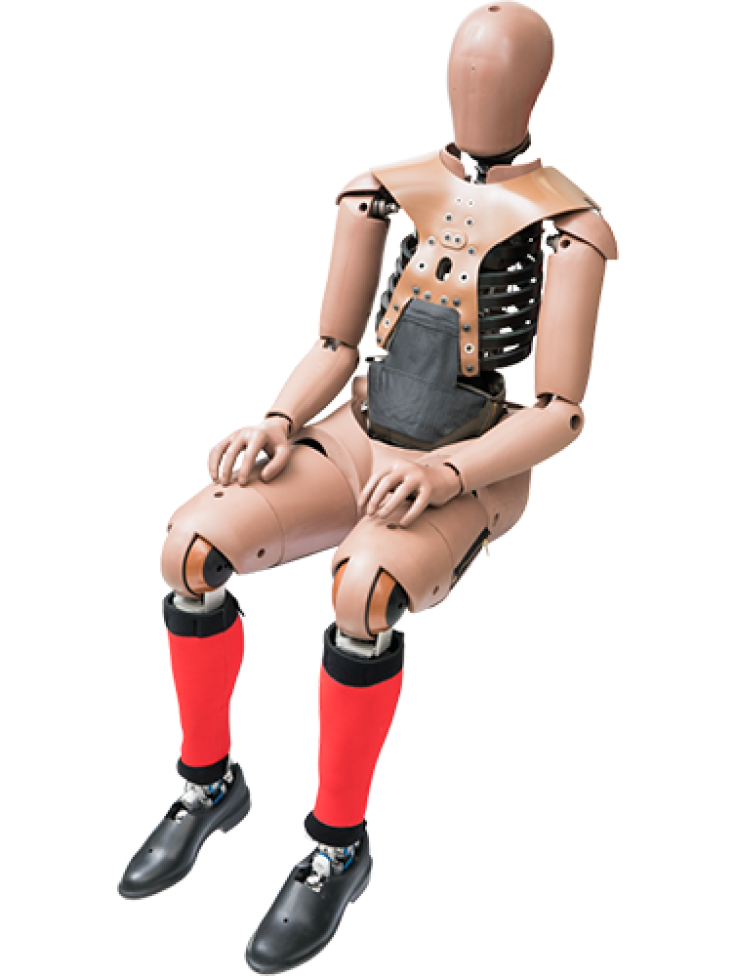
50th percentile male
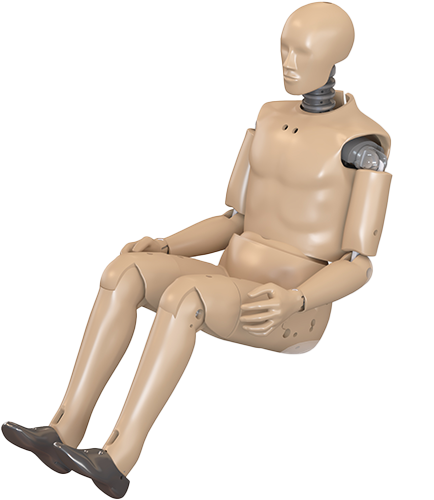
50th percentile male
Hybrid III 50th Percentile Male
Represents
Average adult male
Usage
Frontal impact tests
The Hybrid III dummy is the longest-serving crash test dummy in Saudi NCAP history, used continuously since the first test results were published in 1997. While it performs a similar role to THOR, Hybrid III has more limited biofidelity and measurement capability. Like THOR, its dimensions are based on an average adult male and it is used exclusively in frontal impact assessments. This proven dummy continues to provide valuable baseline safety data.
Test Application:
Adult occupant protection: Passenger position in frontal impact – Mobile Progressive Deformable Barrier test
Hybrid III 5th Percentile Female
Represents
Small adult female
Usage
Frontal impact tests
This Hybrid III variant represents a small adult female occupant—a critical addition to ensure vehicle safety systems protect people of all sizes. While structurally similar to its larger male counterpart, this dummy is shorter in stature and includes female physical characteristics. It has the same measurement capabilities as the male version and is used exclusively in frontal impact tests to evaluate safety system performance for smaller occupants.
Test Application:
Adult occupant protection: Driver and rear-seat occupant positions in frontal impact – Full-width rigid barrier test
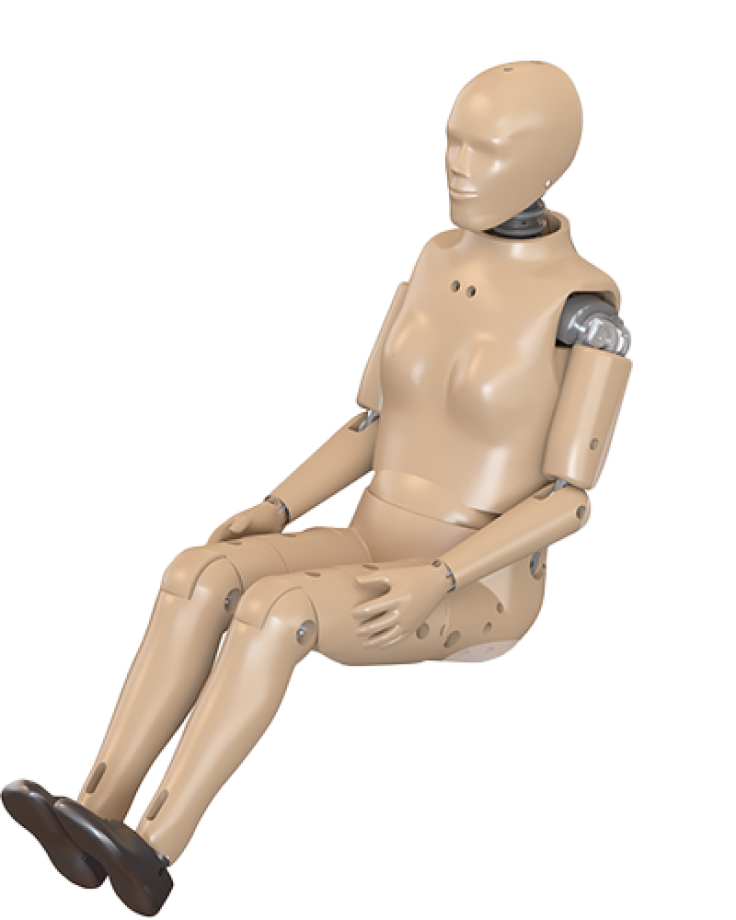
5th percentile female
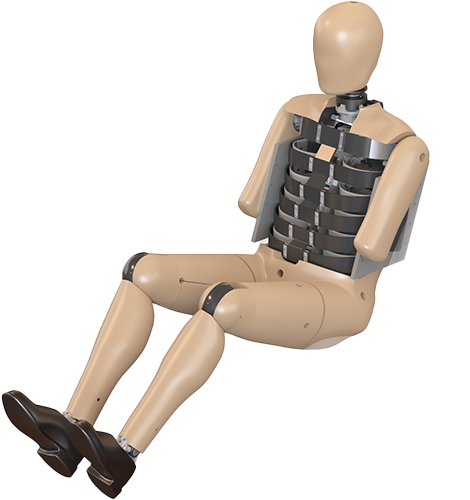
50th percentile male
WorldSID 50th Percentile Male
Represents
Average adult male
Usage
Side impact tests
The WorldSID dummy was built specifically for side-impact scenarios, designed to simulate car-to-car and car-to-narrow-object side impacts. It can be impacted from both left and right sides, making it suitable for testing left- and right-hand-drive vehicles. It measures forces on the head, neck, chest, abdomen and pelvis—the body regions most at risk in side impacts. Its dimensions match those of an average adult male.
Test Application:
Adult occupant protection: Driver and front passenger in side impact – Side barrier and pole tests (where fitted); driver position in far-side impact test
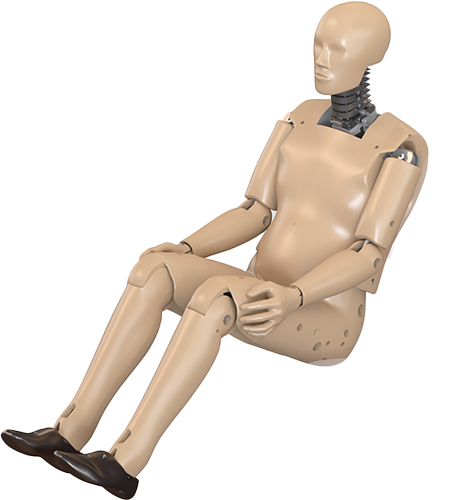
BioRID UN 50th Percentile Male
Represents
Average adult male
Usage
Rear-impact whiplash tests
The BioRID dummy serves a highly specialised purpose—assessing whiplash protection in rear-end collisions. It features a remarkably human-like spine with sophisticated instrumentation that measures loading forces from the cervical (neck) to the lumbar (lower back) region. This detailed measurement capability is essential for evaluating seat and head restraint design. The dummy's size and shape reflect those of an average adult male.
Test Application:
Adult occupant protection: Rear impact – Whiplash test
50th percentile male
Child Occupant Dummies
Q10 Child Dummy
Represents
10-year-old child
Usage
Child restraint system tests
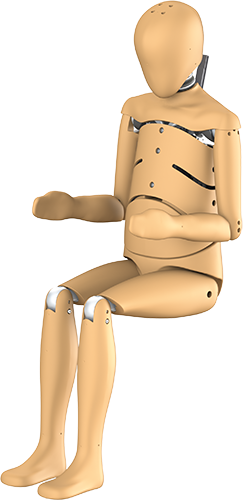
The Q10 is the largest of the child dummy family used by Saudi NCAP, designed to simulate a 10-year-old child. It can measure impact forces in both frontal and side impact scenarios, although it does not have the same extensive instrumentation as adult dummies. It plays a vital role in assessing how well vehicles and child restraint systems protect older children in crashes.
Test Application:
Child occupant protection: Rear-seat occupant in frontal impact – MPDB test; side impact – side barrier tests
10-year-old child
6-year-old child
Q6 Child Dummy
Represents
6-year-old child
Usage
Child restraint system tests
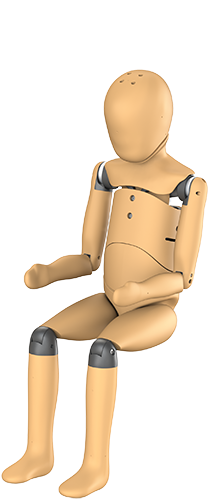
Smaller than the Q10, the Q6 dummy accurately simulates the physical characteristics of a 6-year-old child. Like its larger counterpart, it can be used in both frontal and side impact tests with similar measurement capabilities. Together with the Q10, it ensures that child protection systems perform effectively across age groups and sizes.
Test Application:
Child occupant protection: Rear-seat occupant in frontal impact – MPDB test; side impact – side barrier tests
Pedestrian and Cyclist Impact Tests
Pedestrian Headforms
Represents
Adult and child pedestrians
Usage
Head impact tests
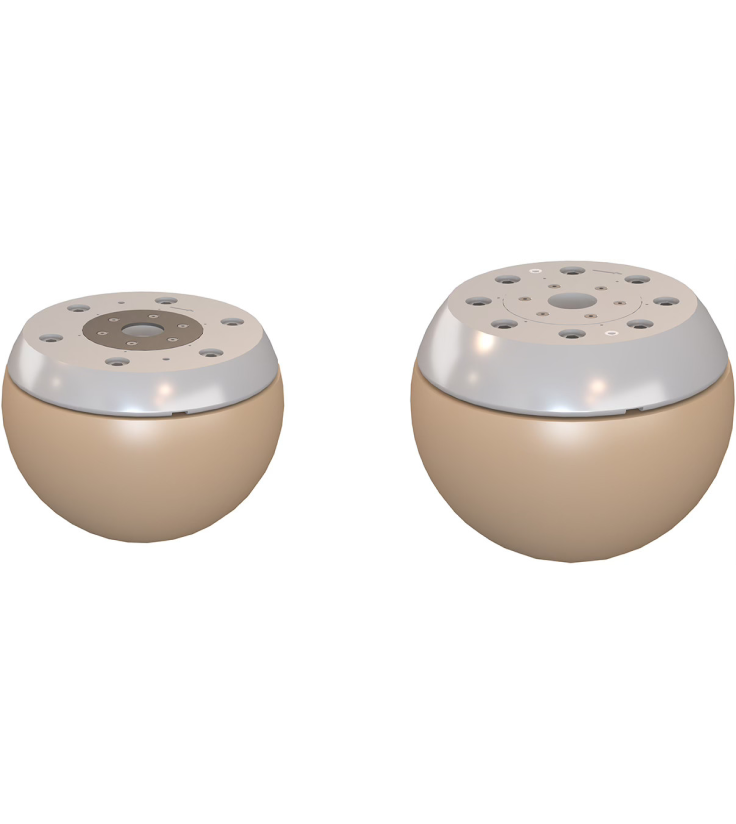
Saudi NCAP uses two headform impactors in pedestrian safety tests—one representing an adult and a smaller one for children. Rather than full-body models, these headforms provide more reliable and repeatable test data. They assess the risk of head injury when pedestrians or cyclists strike the bonnet, windscreen and vehicle support structures during impacts.
Test Application:
Vulnerable road user protection: Head impact tests
Small adult (3.5 kg) and adult (4.5 kg)
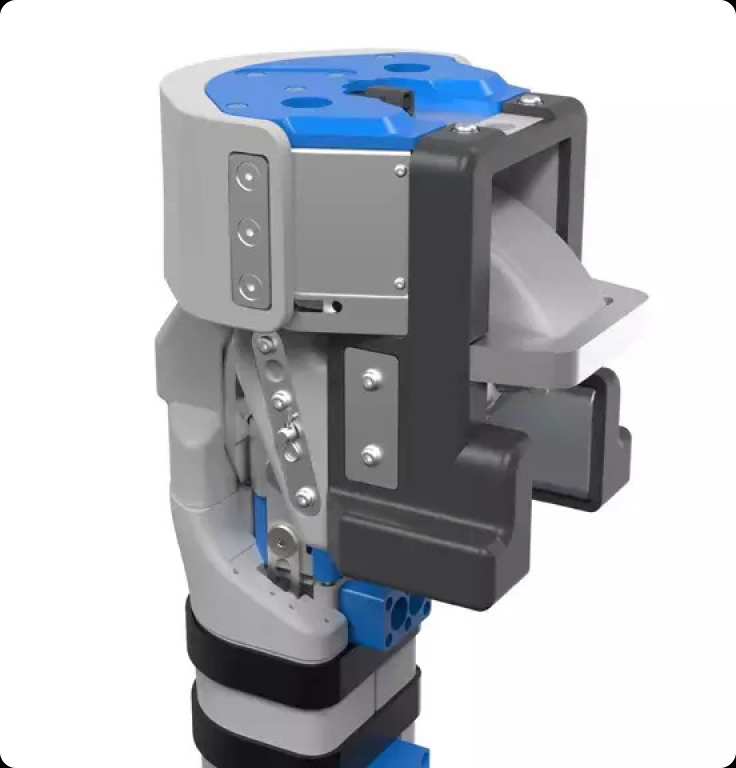
Pelvis and femur impact device
Upper Legform Impactor
Represents
Adult pedestrian pelvis
Usage
Pelvis impact tests
This specialist impactor assesses the area of the vehicle where the pedestrian's pelvis and upper leg (femur) would make contact in a collision. It is a simplified but highly effective test device that records impact forces and bending moments, providing critical data on the likelihood of pelvis and femur injury in pedestrian impacts.
Test Application:
Vulnerable road user protection: Pelvis impact tests
Legform Impactor
Represents
Adult pedestrian leg
Usage
Lower leg impact tests
The pedestrian legform is designed to test the front bumper and grille area of vehicles. It simulates a human leg from the upper femur to the ankle, with femur, knee joint and tibia—but no foot. Each component is designed to behave in a biofidelic manner like human anatomy. The impactor dimensions are based on the lower limb of an average adult male.
Test Application:
Vulnerable road user protection: Leg impact tests
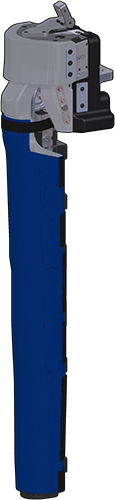
50th percentile male
Active Safety Test Targets
Adult Pedestrian Target
Represents
Walking/running adult
Usage
Pedestrian AEB tests
This advanced target is designed to simulate a pedestrian walking in the street with notable realism. Its legs can move in a way that represents both walking and running gaits by adjusting leg speed. The target dimensions are based on an average adult male. Crucially, it provides realistic sensor signatures—including visual appearance and radar reflectivity—allowing vehicle detection systems to recognise it just as they would a real pedestrian.
Test Application:
Vulnerable road user protection: Pedestrian AEB tests
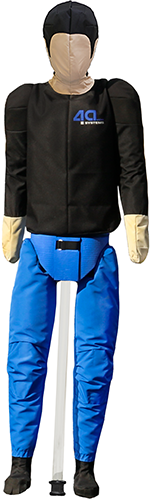
50th percentile male

7-year-old child
Child Pedestrian Target
Represents
Walking/running child
Usage
Pedestrian AEB tests
Mirroring the adult target's function, this child pedestrian target simulates a young person who may be walking or running near traffic. Its size is based on an average 7-year-old child and it provides realistic sensor signatures that enable vehicle detection systems to recognise it. Testing with child-sized targets is essential because children present different visual and sensor profiles compared to adults.
Test Application:
Vulnerable road user protection: Pedestrian AEB tests
Cyclist Target
Represents
Cyclist on conventional bicycle
Usage
Cyclist AEB tests
This target is designed to simulate humans riding bicycles in urban environments. It can move at different speeds, and the cyclist form has movable legs that authentically replicate the pedalling motion of a real cyclist. The target dimensions are based on an average-sized male on a typical conventional bicycle—the most common type of bicycle used in Saudi cities.
Test Application:
Vulnerable road user protection: Cyclist AEB tests
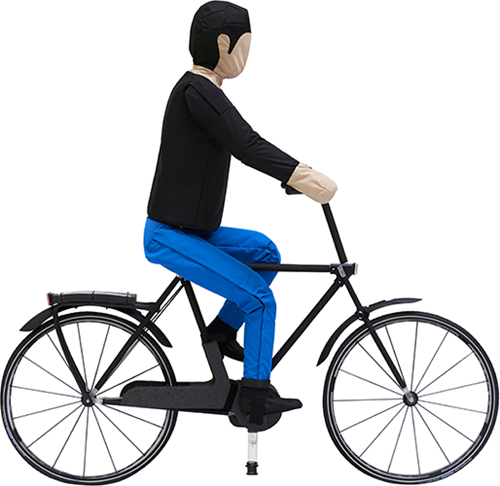
50th percentile male – typical Saudi conventional bicycle
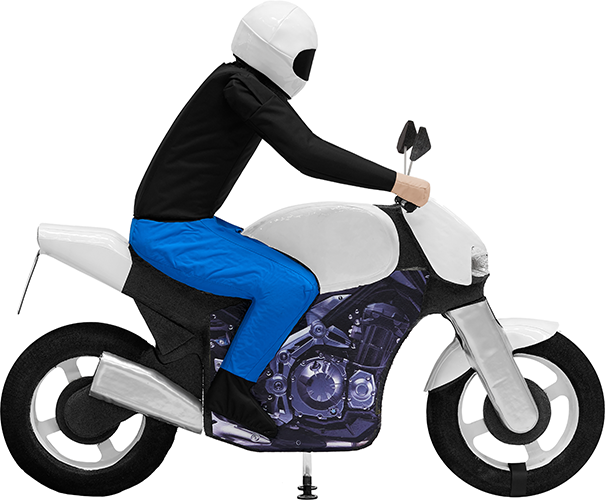
50th percentile male – average registered motorcycle
Motorcyclist Target
Represents
Motorcyclist on standard motorcycle
Usage
AEB / lane support tests
The latest addition to Saudi NCAP's vulnerable road user test family, the motorcyclist target represents a major advance in comprehensive safety assessment. The rider is designed to average adult male size, while the motorcycle represents the typical profile of the most registered motorcycles in Saudi Arabia with engine capacity over 500 cc.
Test Application:
Vulnerable road user protection: Motorcyclist AEB and lane support tests
Global Vehicle Target (GVT)
Represents
Typical small Saudi car
Usage
Car-to-car AEB tests
The Global Vehicle Target is designed to simulate—in terms of size, shape and sensor characteristics—a typical small car commonly driven on Saudi roads. Mounted on a motorised platform, it can move at speed and perform manoeuvres that reflect real-world driving situations. This allows comprehensive testing of how well vehicle AEB systems detect and respond to other vehicles.
Test Application:
Safety assist: Car-to-car AEB tests
.png)
Typical small car
Explore More Resources
Dive deeper into vehicle safety with our other comprehensive guides